




A life of service and craft

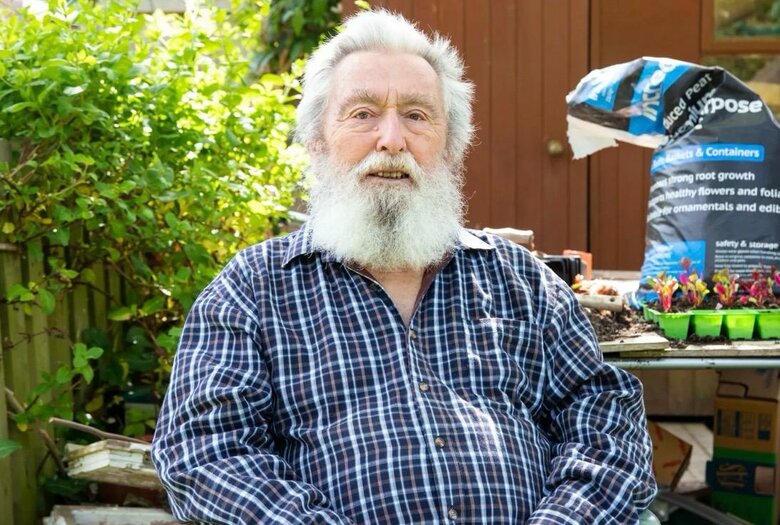
We are sorry to report the death of past pupil George Bruce, who was born in 1937 and attended Ripon Grammar School from 1949 to 1956. George looked back on his life for an article in Watlington Folk in 2023
'Half an hour digging the ground with a fork is the perfect therapy'
I WAS born on the 12th March 1937 in Masham, North Yorkshire. My grandfather had bought the old Theakston’s Brewery, and converted it into a country holiday home with 12 bedrooms, and that is where I was born. So, I was actually born in a brewery!
My grandmother ruled the roost. She was in charge of the cooking, and the family had a mafia of post offices. As a little kid I used to get the firewood and the coal. I was chopping up sticks from the age of four.
When the war started, our farm was taken over by the army, but we retained the tennis court for visitors until 1946, when the council took everything to build a new housing estate.
My dad had left school when he was twelve, when his older brothers had been called up to fight in World War I. He was self-educated. When he was fourteen my grandfather bought a truck but found that driving wasn’t for him, so my dad learned to drive. It was the second private vehicle in the town. The first was the Lord of the Manor’s. My dad worked as a driver and chauffeur for a number of years. He would have been a professional footballer but my grandfather said “Bruces don’t play sport for money”.
When my dad was in his late 30s, he was drafted by the Forestry Commission and took over an ancient forest site that was felling timber and making pit props. Nowadays there would be an outcry but then it was a case of “there’s a war on”. Then, in 1942 there was an explosion where he damaged his leg. As a result I had to help with growing the family’s vegetables on the allotment. I was just six years old. Later, from the age of nine, I used to work on building sites. I worked with an undertaker fella and learnt carpentry skills.
I remember one night there were two bombs that landed on the town. The first one woke me up and the second blew my bedroom window in. I remember the air went purple. The heart of Wensleydale was the last place you’d expect to be bombed.
There was an old-fashioned grammar school in the town. I went there and quite enjoyed it. The headmaster had us in three rows of desks and had a large garden cane. He could reach anyone with it – and he did! It encouraged us to pay attention and learn.
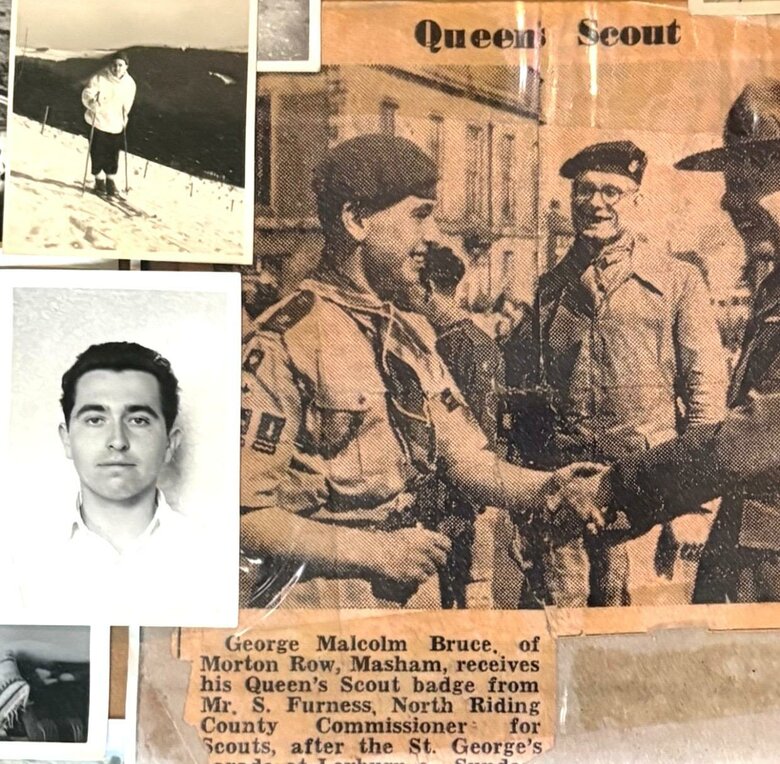
I joined the Scouts and went all the way through. I enjoyed it. I was awarded the Queen’s Scout badge and went to Gilwell Park in Essex where it was awarded by the Chief Scout. I also joined the Royal Engineers Cadets at school. Then, when I was eighteen, I joined the Army in the R.E.s and was posted to Germany.
I did all sorts of interesting things there. One time I floated down the River Weser on a pontoon. The rig to the bank had broken. I remember my mate shouted to me “Are we going into the North Sea or the Baltic?” There was an 8 knot current. We came aground at the bottom of a cliff and had to spend the next two days getting everything up to the top. I was very tired and it was raining, so I took cover under a military vehicle and went to sleep. When I woke up the truck had gone and I was soaking wet! I was in the Army for two years, and then I was an emergency reserve for 7 years, which limited where I could be for that time.
I was good at art at school, so I accepted a place a Corsham to study art. It was a beautiful country house near Bath. Chatting to some of the fellow students I realised that I’d met the father of one of them, the Bailiff of the campsite at Gilwell Park! That person was Margaret, and I married her three years later.
I got a job teaching art in Oxford, and Margaret got a job teaching art at the Icknield school in Watlington. We moved here in 1960 and initially rented Meadow Cottage before finding the house that we live in now on Love Lane, which was being built. In those days there were very few houses and it really was a lane. Paul’s Way didn’t exist. When the houses were built, someone wrote that Love Lane was the ugliest street in Oxfordshire. This got in the papers, so the council decided to plant woodland trees along it.
Then In 1966 and 1970 we had our sons, Robert and Ian. Our good friend Maureen Sweeney lodged with us from 1963. She stayed with us until the early 90’s when she moved next door. Maureen was like a little sister to me, and she looked after our children as if they were her own.
We definitely felt we were outsiders when we moved here. Everyone spoke “Watlington” which you don’t hear now. It was very insular. The first couple of years I was busy with work. We’d just have time for a late pint in the Chequers on a Friday night. In those days all the pubs had a minder to keep the peace. Everything used to be settled by fighting in Watlington. I had to pull apart a pair who had been allocated the same allotment and were having a fight about it.
I took on an allotment the second year we were here. It was where the play area is now. A lot of the allotments hadn’t been tended since the end of the war. A chap called Bill Fowler retired here and took over as Parish Clerk, and we set up the Allotment Association. This continued until the farce over the polytunnel, which led to it being taken over by the Parish Council. By this time all the plots were back in use and the allotments were making a profit, which was put into a sink fund to fund future work that might be required. This sink fund has helped fund the new water system which has just gone in. I spend a lot of time on the allotments. After a hard day at work, half an hour of digging the ground with a fork is the perfect therapy!
I don’t remember a time when I was not aware of bowls. My dad and grandfather were founder members of the Masham bowls clubs in the 1920s. I was always made welcome as a lad and I certainly knew enough about it to play Ripon City in 1950. I was also a keen cricketer in my time. Most clubs in our league had an adjacent bowling green. Two of us, both bowlers, would have a “roll up” whilst our side were batting. This was more fun and less expensive than losing money in the Pavilion on card games run by our senior players.
My sporting activities here in Watlington were limited to darts until I went to a meeting called by the War Memorial Club trustees in the late ‘60s. We were told that the premises were so decrepit and underused that the choice was to renovate or sell up. I soon became actively involved in the design and restoration of what had been a series of separate dwellings. The original club had been “dry”. We put in a bar in the middle of what is now called the Georgian Room, and the bowling and tennis sections were asked to support it. Our bowlers left The White Hart to come, which did not go down well with the landlords of that pub.
By now I was the Memorial Club Secretary (I got rid of the word “War”). The bar opened initially on Friday and Saturday evenings, and we soon added Sundays for bowls fixtures. The Sunday evenings paid for the timber and cement used the following week. After matches the bowlers provided their own entertainment. Most of them had a song or a turn. Visiting teams usually stayed very late! Soon I was hooked again on bowls. The bowls section organised a pairs competition, a revolutionary idea at the time, and we were also among the first in the county to play mixed matches.
I became Bowls Chairman in 1980, a post I held for 11 years. For a while I was Chairman of both clubs, a very useful position. We made many improvements off the green, for example, I persuaded neighbours to sell us the ends of their gardens to square the green, giving us five rinks. This made us county standard. I then supervised the building of the new Pavillion. Our membership doubled during this time. I was also Captain for five years from 1982. None of this could have happened without great support from home, for which I am very grateful. Then, after I retired, I got involved in coaching bowls. I still like to play. Long may it continue!
After 30 years teaching ceramics and retiring, I decided to go back to my first love, which was making things out of wood. I bought a lathe and went on a course, and I have been doing that ever since.
Watlington provides peace and tranquility. That’s it really.
Watlington Folk is a documentary project by photographer Nicola Schafer. Watlington is blessed with pretty buildings and beautiful countryside, however it is the people who live here that truly make the place. This project aims to capture that through a series of portraits of the people who live here together with their “Watlington Story”. For more information, please contact Nicola through her website http://www.nicolaschafer.co.uk
Share this:
Ripon Grammar School, 16 Clotherholme Road, Ripon, North Yorkshire, HG4 2DG
Tel: 01765 602 647
E: admin@ripongrammar.com


