




The long road to finding home following a life-changing journey of courage and resilience

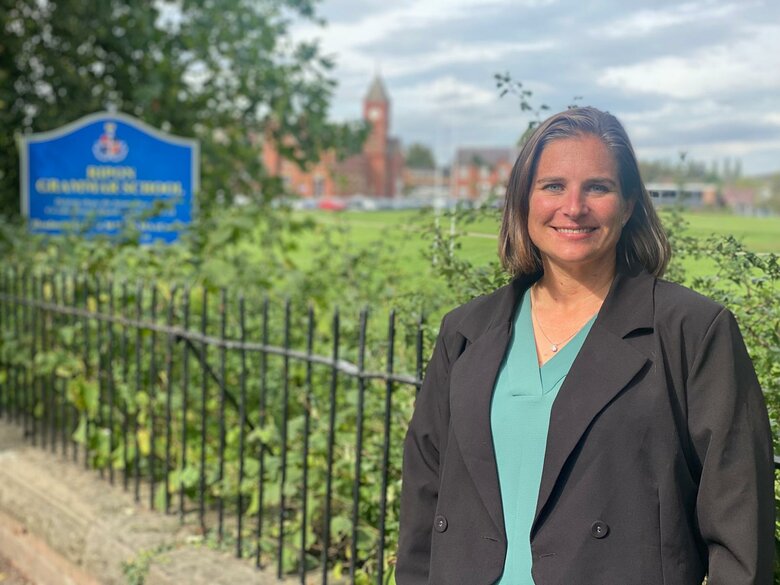
After leaving behind her home, career and family life in South Africa, RGS sixth form administrator Karyn Feingold describes the challenges of starting again in the UK - and how an unexpected school landmark helped her find a sense of belonging
FOR RGS Sixth Form administrator Karyn Feingold, moving to the UK was much more than an exciting new chapter. It was the culmination of a painfully difficult journey that saw her family leave everything they knew behind in South Africa and start again in a new country.
The decision to emigrate came in July 2021, following a period of civil unrest that left Karyn, her husband and their young son questioning their future.
The family had been due to spend a short holiday in the Drakensberg mountains when protests erupted following the imprisonment of South Africa's former president.
What began as disruption on the roads quickly escalated into widespread rioting and looting, with shopping centres, businesses, vehicles and infrastructure destroyed.
Stranded in a rural area with dwindling food supplies and little prospect of travelling safely home, the family faced an agonising decision. Eventually, they managed to find a back route to reach Karyn's parents in Johannesburg, where they could take refuge and make plans.
The experience proved a turning point.
Returning home, they found their own property had escaped damage, thanks to neighbours who had united to protect their community. But the family no longer felt secure about their future. They decided they did not want their son growing up surrounded by such uncertainty and fear.
"We decided we could not live like this," Karyn explains. "We did not want that type of life for ourselves or our son."
The family began making plans to emigrate to the UK, a decision that meant leaving behind far more than their home. Karyn had recently been offered what she describes as her dream job - heading up a nursery school and becoming a deputy principal. Having worked hard to build her career in education, turning it down was a particularly difficult sacrifice.
There were also practical challenges. Her husband needed to wind down his business, their house had to be sold and their belongings packed up. Karyn's parents and in-laws also decided to make the move to the UK, meaning the family would all be leaving behind their established lives, friends and extended family.
By the end of January 2022, their house was on the market, Karyn had resigned from her job and preparations were well underway. The house sold within a fortnight, and the family booked flights for the end of April.
But their plans were about to become considerably more complicated.
While waiting for their visas, Karyn became seriously ill. Initially diagnosed with stress-related stomach ulcers, further investigations revealed she had contracted hepatitis A and was suffering from significant liver problems.
She was admitted to strict bed rest and unable to return to work to say a proper goodbye to the children she had been teaching.
Meanwhile, the family's visa applications were delayed far beyond the expected four-week processing time. With their house sold, belongings shipped to Britain and medical cover cancelled, the situation became increasingly precarious.
Eventually, her husband had to travel to the UK alone to take up a new job, leaving Karyn and their five-year-old son behind in South Africa.
What followed was a particularly difficult period. Having handed over the keys to their home, Karyn and her son spent four weeks moving between temporary accommodation, friends' homes and an Airbnb, living out of their bags while waiting for permission to join her husband.
The visa delay ultimately meant they arrived six weeks later than planned. Karyn then faced the prospect of travelling halfway across the world alone with her young son, during the Covid period, with just four bags containing everything they had left.
"Arriving in the UK, we had to start again from scratch," she says. "We didn't own coat hangers, plates, mugs, knives, forks, spoons, linen or anything. We literally had to start again from the beginning."
There were further professional challenges, too. Despite more than 12 years' teaching experience, including work supporting children with special educational needs and disabilities and over five years in management, Karyn found that her South African early-years qualifications were not recognised for the purposes of gaining qualified teacher status in England.
It meant rebuilding her professional life as well as her family's home.
Finding a sense of home
When Karyn and her family arrived in Ripon, they had only been in the UK for a few months when an unexpected encounter began to make their new surroundings feel a little more familiar.
One autumn morning, Karyn went for a run along Lark Lane. As the sky began to lighten, she noticed a brightly illuminated clocktower standing out against the darkness.
She was puzzled. She knew she wasn't close enough to the centre of town to be looking at Ripon's famous cathedral clock tower.
A few days later, she took her son to his first football practice. As they drove up the driveway of Ripon Grammar School, she spotted the clocktower again. Suddenly, she recognised it.
That small moment had a profound effect.
Having moved across the world, leaving behind almost everything familiar and arriving in a place where she initially felt lost, Karyn had found a landmark she recognised. It gave her a sense of knowing where she was and, for the first time, of feeling at home.
Within a year, she had joined the RGS staff, becoming part of the school community that had unknowingly helped her find her bearings.
The clocktower has remained particularly special to her ever since, appearing in many of her photographs and serving as a reminder of that first feeling of familiarity and belonging.
Now, following its restoration by RGS caretaker Matthew, who took on the project of getting the clock working and its bells chiming again, Karyn has experienced another emotional connection with the landmark.
She was delighted when Matthew invited her to see the working clock and hear the bells for the first time.
For her, it was about much more than restoring a piece of school history.
Seeing it working again brought back memories of that autumn morning when its light had shone like a lighthouse against the dark sky, helping her feel less lost in an unfamiliar place.
"When I hear the bells, I feel a sense of being home," she says.
For someone who has experienced so much upheaval and had to rebuild so much from scratch, that feeling of belonging is particularly precious.
And while the clocktower may simply be a familiar feature of the school to many, for Karyn it represents something much more significant: the moment a new place began to feel like home.
Ripon Grammar School, 16 Clotherholme Road, Ripon, North Yorkshire, HG4 2DG
Tel: 01765 602 647
E: admin@ripongrammar.com


