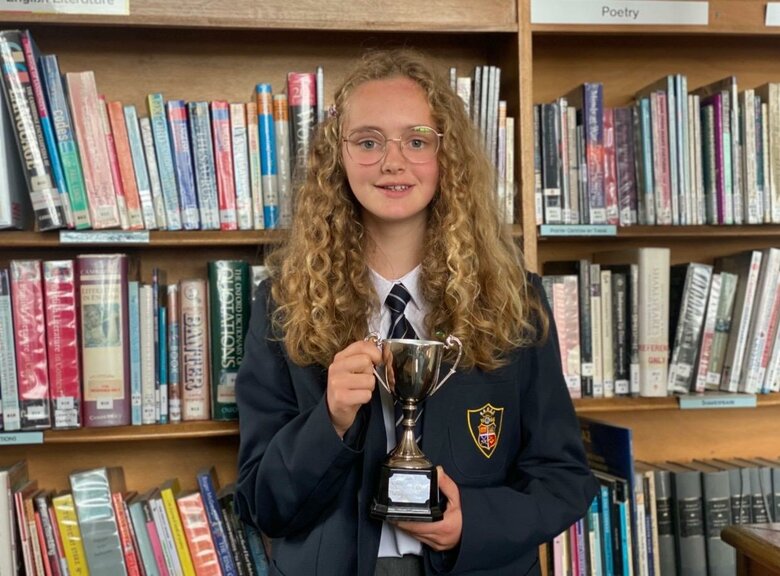
Student keeps the Faith to work wonders with words
Year 10 student Faith Harford has won the Paul Hullah Poetry Prize with her poignant poem while head of economics Mr Demir has been awarded the prize for adult entrants with his emotionally powerful work. You can read the poems below
A TALENTED RGS student has taken top prize in a prestigious competition with her poignant poem exploring love, loss and memory.
Year 10 student Faith Harford from Markington, was named winner of the Paul Hullah Poetry Prize, 2026, for In Memory.
It is a particularly special achievement for Faith, who was runner-up in last year’s competition and was selected from an exceptionally strong field of entries this year.
Dr Hullah, the distinguished poet, author and former RGS student who judges the annual competition, described the range of voices, styles and ideas as jaw-droppingly inspirational, with more submissions than ever before.
Faith was inspired by this year’s theme of ‘Noise and Silence’ to write about a music box and the contrast between the noise of life and the silence of grief.
“I really liked the idea of a musical object representing a person, so I played with that theme until I arrived at the music box representing a loved one, most likely a grandparent,” she said.
The theme also has a personal resonance for the 14-year-old, who is heavily involved in music both in and outside school.
Dr Hullah praises her as a ‘standout writer working wonders with words’, describing her entry as ‘elevated observational poetry laced with authenticity’.
He commends the way Faith uses a music box as a touching symbol of memory and loss, conveying grief with warmth and quiet restraint.
The poem initially centres on a musical object and its connection with a loved one, before developing into a wider reflection on memory, mortality and the enduring importance of human relationships.
Dr Hullah says he initially wondered whether the connection to the competition theme might be tenuous, before the closing image of the music box silently gathering dust brought the theme of noise and silence powerfully into focus.
He concludes: “You had to be there. I’m so glad you ‘kept the faith’, Faith. You’re a VERY talented writer.”
Faith, who has been writing poetry since she was very young, only began entering competitions last year.
Although she hopes to continue pursuing those interests as she gets older, the teenager, who is also involved in drama and Girlguiding, sees poetry remaining a hobby rather than a career.
She counts poet Brian Bilston among her inspirations, admiring his playful and clever style.
“I feel honoured and proud to have won this competition, and it has inspired me to keep writing poetry in years to come,” she said.
Caitlin Drummond, with Not Enough, was a joint runner-up, praised for a courageous and emotionally powerful exploration of self-doubt and the inner noise of modern life.
Also joint runner-up was Alice Beesley, whose poem Not Every Silence Is Empty was described as a mature and deeply reflective exploration of digital noise, meaningful silence and self-discovery.
Eddie Lake, with River Silence, was the third joint runner-up, with Dr Hullah praising its evocative imagery and thoughtful interpretation of silence.
Izzy Robson (Noise and Silence), Bethany Welford (Silence) and Alma Jones (Noise and Silence) were highly commended.
Dr Hullah said that every entry deserved recognition, praising the quality and variety of the writing submitted by RGS students.
“No duds. Promise and eloquence everywhere, and it is an honour to read such beautiful writing, rich in variety yet consistent in quality.”

The RGS Parents and Old Rips Prize was won by Mr Demir, RGS head of economics and business studies, for A Thousand Miles.
Dr Hullah describes the poem as an ambitious and emotionally powerful exploration of the silence within a disintegrating relationship, praising its striking honesty and remarkable poetic maturity.
He highlights the poem’s rich imagery, compelling metaphors and sustained emotional intensity, saying it created a vivid portrait of love, resentment, duty and loss.
The recurring contrast between spoken conflict and devastating silence, he said, reflected the competition theme with great sophistication.
Dr Hullah ultimately sums up the work as a memorable, affecting poem demonstrating considerable originality, technical skill, and an impressive command of language.
Rosemary Punshon, with The Architecture of Silence, and Sally Muir, with Threshold, were joint runners-up in the adult category.
The Paul Hullah Poetry Prize has been running at RGS since 2014 and is open to current students as well as parents and former pupils.
Dr Hullah, a former RGS student and acclaimed poet and author, returns each year to judge the competition and celebrate the school’s emerging poetic talent.
Faith's prizewinning poem:
In memory
The music box meant cookies.
freshly baked.
a warm house
floral curtains
tables carpeted with lace.
The music box meant friendship.
gentle hands
smiling eyes.
someone who would crack you up, and held you when you cried.
The music box meant comfort.
The music box meant hope.
quiet jewels of wisdom when you needed them the most.
though you still need them the most.
now the music box is hidden
with the curtains and the lace
buried in the pain.
music box
in a cardboard box
silently gathering dust.
Mr Demir's prizewinning poem:
A thousand miles
When we flung open the windows of youthful love,
You would smile when my name was mentioned
In our voices were the songs of lovers,
Telling the story of our beginning -
Quaint notions of fate and eternal being
Yesterday’s flowers brown down in grey water
Our world, and its cloying little lie,
A product of your mind and your will
Without conviction, I begin the sly and lazy climb out of your life
Our children, the reason not to find a way back
Children, and the meanness of their needs,
Make the world smaller
For me, the fit too tight
They shifted the perspective
And my straitjacket of parenthood, is your coat of many colours
You nail your womanhood to the cross of servitude
I fight aimlessly against a fair share of the chains
And slowly go to seed
The ugly truth, planted in a flabby chair
My decline, traced in the attitude of your face
And your sterile courtesies and vengeful humility,
A union of pity and contempt
You carry the daily burden like a weapon
Bullets, bullets, bullets
Your words, fired out of a smile
You take me apart,
With a butcher’s eye for the bone
Enfeebled, I fightback with words chosen to wound
But they fall out of my mouth like rocks
I say that your chemical cures will never bleach the grey out of life
I say that we live under a layer of dust
You look away, eyes burning through the void
Lythe and sleepy tigress regarding prey
A prisoner of your superlative silence,
I dread the magnificence of your indifference
In my mind, I give almost everything, but there is always poison in the gift
At least enough, to wither the roots of conditional love
Finally, the chokehold loosening,
The cool swell between us flattens as you drift clear,
Behind that weightless, salt-lipped smile
And I could run a thousand miles
From the absence in those unanswerable eyes.
Dr Hullah's report:
A. RGS PUPILS PRIZE 2026
Heartfelt thanks to all the young dudes that set their sights on something better and wrote a poem or two this year. More entries than ever before, the standard outrageously high, the range of voices, styles, and ideas jaw-droppingly inspirational. Someone at RGS is doing something right.
Each year my self-decreed glorious, privileged task becomes more difficult. Bittersweet. As those great philosophers of modern consciousness, Hot Chocolate, sang in 1978. ‘Everyone’s a winner, baby, that’s no lie…’ Never fails to satisfy.
Ultimately, in poetry and in life, difficult decisions have to be made. A different theme, a different year, a different outcome assured, but, here and now and in England, congratulations and, here goes. The most notable baubles go to…
Highly Commended: IZZY ROBSON ‘Noise And Silence’
Ooh, one of the bravest things a poet can attempt: a ‘standard acrostic’ where the initial letter of each line spells a word/phrase (Here NOISE AND SILENCE) from top to bottom. And Izzy pulls it off with aplomb, due to less blatant but insistent rhetorical treasures elsewhere. The canny rhyming, and some quietly affecting imagery – ‘Soft whispers fall like never-ending rain / Endless quiet wraps around my mind’: read that first line aloud and tell me it’s not wonderful, and that subsequent ‘quiet wraps around’ drives the atmospheric figurative juggling home.
Highly Commended: BETHANY WELFORD ’Silence’
A vivid and compelling exploration overwhelming noise. Some strong sensory imagery and an effective emotional progression towards the comfort of silence. One feels like a voyeur here, but welcome too, as private thoughts are made public so engagingly. The contrast between chaos and calm is candidly but carefully managed, a meaningful message communicated with sincerity and confidence. And I learnt a new word from this exquisitely controlled observational piece – ‘petrichor’ – and. more than that, I learnt how to use it beautifully in a mellifluously expressed gentle poem about the inner and the outer parts of our being. Lovely writing.
Highly Commended: ALMA JONES ‘Noise and Silence’
What comes across initially as modestly casual poetry here in fact carefully captures the rhythm of everyday life with vivid sound imagery and a thoughtful contrast between constant noise and restorative silence. Strong sensory details make familiar moments feel engaging and relatable. The subtly manoeuvred shift towards silence is particularly effective. Refining a few word choices might enhance the poem’s impact but, overall, it is an accomplished, evocative response to the competition theme.
JOINT RUNNER UP: CAITLIN DRUMMOND ‘Not Enough’
Brilliant title: haunting poem. This brutally honest piece explores the inner noise of self-doubt with honesty, emotional depth, and striking originality. Effective repetition, varied spacing, and vivid metaphors reinforce its message, while the contrast between noise and silence is compelling throughout, though tightening a few longer passages would aid fluency: it rambles a bit. One more edit… Nonetheless, a memorable, courageous, and highly accomplished evocation of what it is to ‘be’ in the chaotic world we have made for our own torment, our normalised self-torture. I will remember this poem every time I speak to a troubled young person now, and I speak to many. Thank you, Caitlin. Empowering.
JOINT RUNNER UP: ALICE BEESLEY ‘Not Every Silence Is Empty’
Tremendously ‘noir’ opening: ‘The first might / they panicked,’ And it doesn’t disappoint,. This free verse poem triumphs because it runs on dramatic rhythms which captivate addictively and house thoughtful contrasts between digital noise and meaningful silence, using vivid imagery and effective tonal variations. The gradual transformation from panic to self-discovery is credible and inspiring. Creative spacings reinforce the message, while the closing lines leave a lasting impression. It is remarkable that a schoolgirl can muse with such maturity, insight, and emotional intelligence, expressing such complex idea through confident, original and deeply reflective and deceptively nonchalant prosody. Talent beyond your years, Alice. Please stay with it.
JOINT RUNNER UP: EDDIE LAKE ‘River Silence’
This poem captures the quiet rhythm of a riverside reflection with clear, evocative imagery and a thoughtful interpretation of silence as something living rather than empty. The gentle pace suits the theme, although the phrasing could be more varied and the line ‘them all is still again’ feels slightly predictable. Just that? An opportunity missed?. Overall, it is reflective, well-crafted, and emotionally engaging throughout. Eddie evokes the restrained but precise manner of early Romantic poetry, leaving a calm, accessible and memorable impression on a receptive reader. Genuinely original and palpably contemporary poetic promise and confident expression here too. But that last stanza starts on a plaintive sing-song that, I feel, is, alas, ultimately anti-climactic. A judiciously sensitively placed adjective before ‘day’ and changing ‘the’ to ‘a(nother)’ in the last line, and this would have been the winner. Nonetheless, a brilliant, pensive, meditative poem from a writer of considerable talent.
WINNER: FAITH HARFORD ‘In Memory’
Ah, so gratifying to find that a ‘runner up’ from last year has persevered and is this year’s winner! Now that’s what I call poetry. A standout writer still working wonders with words. This is elevated observational poetry laced with authenticity. A poignant, naturalistic poem (and yet somehow bringing to mind T.S. Eliot’s Objective Correlative: a literary device used to express internal emotions by showing objects instead of telling feelings) conveys grief with warmth and quiet restraint, using the music box as a touching symbol of memory and loss. The Tennysonian title is a thoughtful knowing nod too, stretching the reflective tone of this moving, heartfelt tribute. And just when I started to suspect that the connection to this year’s theme might be tenuous and I’d have to blow a big whistle… the ‘in a cardboard box / silently gathering dust’ last lines went and broke my heart. The beautifully rendered recollection of once-musical objects now silenced in the loss of loved ones becomes a transcendent emotional and moral reflection on our own mortality and the enduring value of human relationships.
You had to be there. I’m so glad you ‘kept the faith’, Faith. You’re a VERY talented writer.
B. RGS PARENTS & OLD RIPS PRIZE 2026 All the older dudes offered poems disarmingly splendid too. Perceptive prosodies of pensiveness and pain, all palpable and present, but never allowed to cloy or get twee. Give up the day job, all of you, if you can, is my short, sweet, advice. Or at least KEEP WRITING. You’ll leave a meaningful footprint if you can express yourself in poetry as beautifully as this…
JOINT RUNNER UP: ROSEMARY PUNSHON ‘The Architecture of Silence’
A thoughtful exploration of silence’s contrasting emotional ‘architectures’, using vivid, relatable imagery and a graceful progression from loneliness to comfort. The repetition creates cohesion, while the closing reflection leaves a lasting impression that fits the theme beautifully. To introduce a more unexpected image or metaphor along the way might heighten originality, as several examples feel familiar: on the other hand, that very familiarity is arguably part of the poem’s purpose: its gentle enactment of comfort in progress, false starts and all. An engaging, emotionally resonant piece with authentic emotional intelligence, potency, and a depth that lingers long after the page is turned. The last line – ‘I am learning the difference’ – is superb.
JOINT RUNNER UP: SALLY MUIR ‘Threshold’
This poem captures the profound silence of grief with restraint and sincerity, allowing understated language to convey deep emotional loss. The domestic setting and the spider as silent witness create intimate, memorable images, while the closing reflection balances hope with realism. The poem’s simplicity suits the theme well and invites empathy. A central spider metaphor adds a lot but maybe a bit more distinctive sensory detail would deepen the already considerable impact of this sedulously plotted piece? But, as it is, it is a moving and emotionally authentic meditation on silence as a useful and usable reality. Last stanza a triumph.
WINNER: H. DEMIR: ‘A Thousand Miles’
But THIS was an easy call. Wow. I googled and googled, but the ‘H’ remains elusive. That was the only difficult bit. For this is an ambitious, emotionally powerful poem that explores the silence within a disintegrating relationship with striking honesty and remarkable poetic maturity. Its rich imagery, compelling metaphors, and sustained emotional intensity create a vivid portrait of love, resentment, duty, and loss. The recurring interplay between spoken conflict and devastating silence reflects the competition theme with great sophistication. A few putative ‘digressions’ could be sharpened to maintain rather than interrupt the poem’s momentum, but the lyrical confidence and psychological depth on display here are exceptional. Overall, this is a memorable, affecting work that demonstrates considerable originality, technical skill, and an impressive command of language. There is some obliqueness, but, through layered metaphor, shifting symbolism, and relentless emotional escalation, the poem seems to chart the slow disintegration of a marriage from youthful idealism to irrevocable estrangement, deriving its emotional power from the unsparing honesty with which mutual love curdles into mutual imprisonment, resentment, and finally the unbearable emptiness of indifference. Probably. But who am I to say? Happy to have such a brilliant poem take the title this year, though. Bravo.
I parrot this every year, but/because it is true. Every entry deserves a mention and a prize. No duds. Promise and eloquence everywhere, and it is an honour to read such beautiful writing, rich in variety yet consistent in quality. Language is undoubtedly humanity’s greatest invention, and literature is its reward. The early Romantic poets, especially William Wordsworth, showed us the way, believed that nature could heal and teach us, childhood preserved a special wisdom, imagination revealed deeper truths, and genuine emotions were more valuable than cold logic or strict rules. Their poetry was revolutionary because it rejected formal traditions and celebrated ordinary people, everyday life, personal feelings, and the transforming power of nature and the individual imagination. Much of what I have read this year reassures me that, here at the start of the second major industrial revolution, there are young people (and some not perhaps so young) with clear moral and poetic vision, aware of what we need to cherish and look after: language, nature, and above all ourselves and those whom we encounter along this increasingly noisy and stressful journey we call life. Poetry such as this I have read this year quietens the anxieties in a way well-chosen words framing useful sentiments can. My sincerest gratitude to all involved,
Another privileged task, the judging, that brought many a smile and many a tear: these are such impressive pieces of writing, as were the ones that didn’t get a mention, though they ALL certainly merited such. I am especially indebted and grateful to the pupils (and their teachers) for getting down dirty and putting pen to paper with nought but experience and emotion, in an age when ChatGPT et al stand tantalisingly close with their reductive insidious offer of poetic output in seconds that will be ‘good’ and might even be undetectable as such, but never really ours. If anyone did use AI in the creation of any of the poems I have singled out for praise, well, have you really done anything worthwhile?